
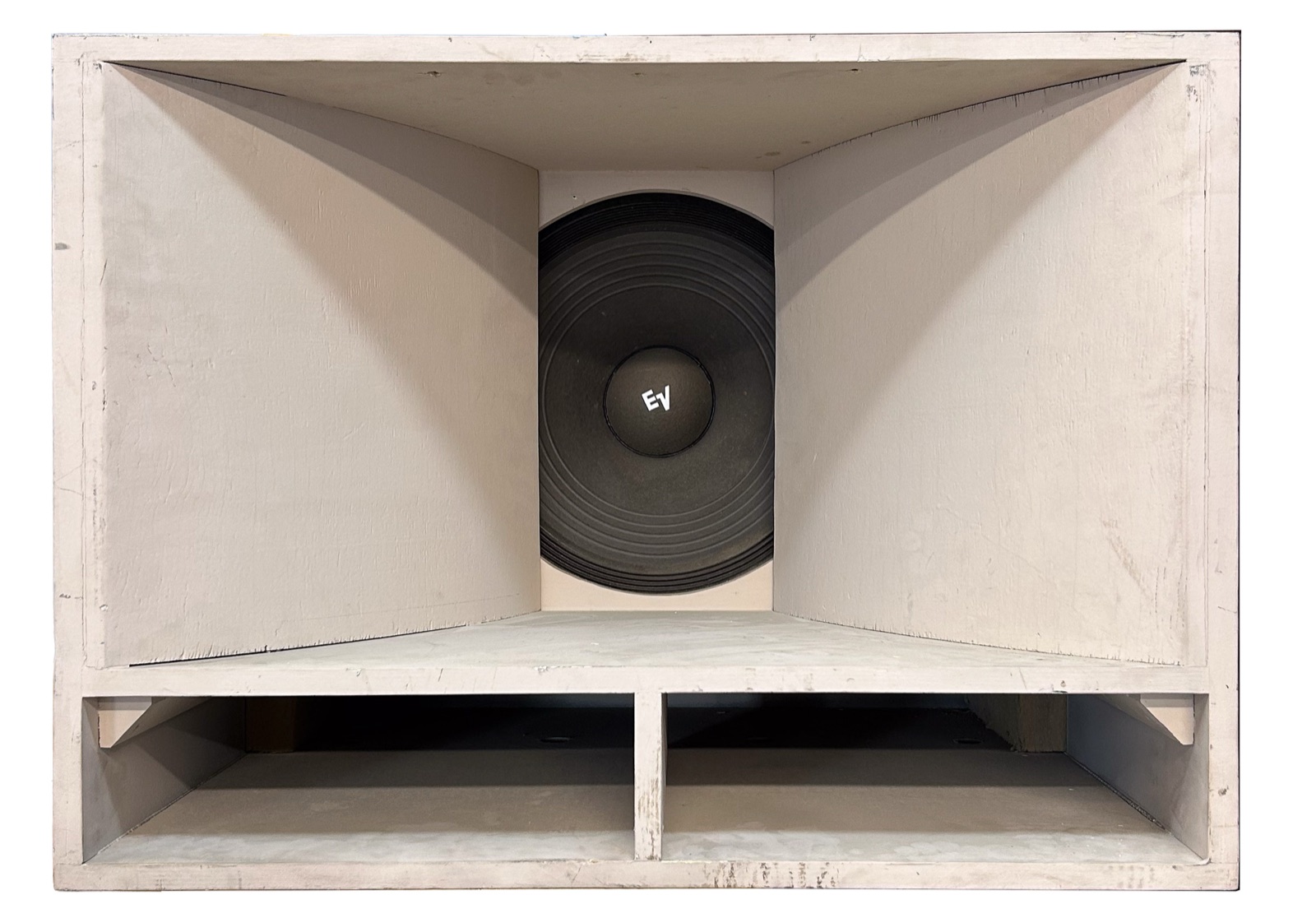
The kicks play the bass you hear with your ears, not your chest: the punch of the kick drum and the speed of the bass line, 80 to 300 Hz. They are two Electro-Voice EVM-15L Series II 15" drivers, each in an Altec 816A cabinet, one amplifier channel per cabinet. Until October 2026 the kicks had JBL 2226Hs, and we moved those to the scoops.
A musical-instrument driver: a light cone and a strong magnet give high efficiency, at the cost of short cone travel.
Two boxes in one. The 816A puts a short horn in front of the driver and a ported box behind it. The horn adds output above about 150 to 200 Hz and the port carries the bottom, so the response steps up, as it does in most cabinets of this kind.
Why 80 Hz. Scoops are known for a dip around 70 to 90 Hz, where the kick and the speed of the bass are heard, and crossing at 80 Hz lets the kicks carry it. Measured, these scoops show no dip and stay strong to about 120 Hz, so 80 Hz stays and 100 Hz is an option to try by ear: the EVM kicks come alive above 100 Hz.
Why 300 Hz. Kick bins can play to 400 Hz and beyond, but a 15" driver starts to beam (narrow its pattern) not far above 300 Hz. Stopping at 300 Hz keeps the pattern wide, and moving the mid's low corner up from 180 to 300 Hz cut its excursion demand 2.8 times.
Why the EVM is here, not in the scoops. Measured with REW (2026-10-19), the EVM in the 816A is about 5.5 to 6 dB more sensitive than the 2226H from 90 to 300 Hz, and it fills the old hole at 150 to 200 Hz. Its short travel (3.3 mm) ran out in the scoops at 50 to 80 Hz; above 80 Hz the cone moves far less. The 2226H, with 2.3 times the travel, does more good in the scoops.
Excursion. Modelled at the limiter (200 W) with the 80 Hz LR24 high-pass, the EVM comes close to its Xmax, about 88 to 97 % in two runs of the model, with the peak near 100 Hz. The 816A's volume and tuning are unpublished, so 140 to 190 L tuned 40 to 50 Hz was modelled. So 200 W is both the driver's rating and about as far as its travel goes.
The limit is the driver's 200 W rating, which with the 80 Hz high-pass is also close to its Xmax. The GX5 could give 465 W, so the limiter, not the amp, protects the kicks. The gain was set by ear on 2026-10-22 at -3 dB and trimmed to -2 on 2026-10-23, well above the paper model's -10.7 and the -8 start point; the model left the rig far too bright.
The two kicks lie flat, 30" face across and 21-3/4" tall, side by side and touching in the middle, on the level platform formed by the scoop platform boxes and the top of the subs. The wedge mid sits centered on their seam with the 2350 horn on top of it.
The 816A's old 75 to 100 W rating belongs to the original Altec drivers, not to the box; the EVM's own 200 W rating applies.