
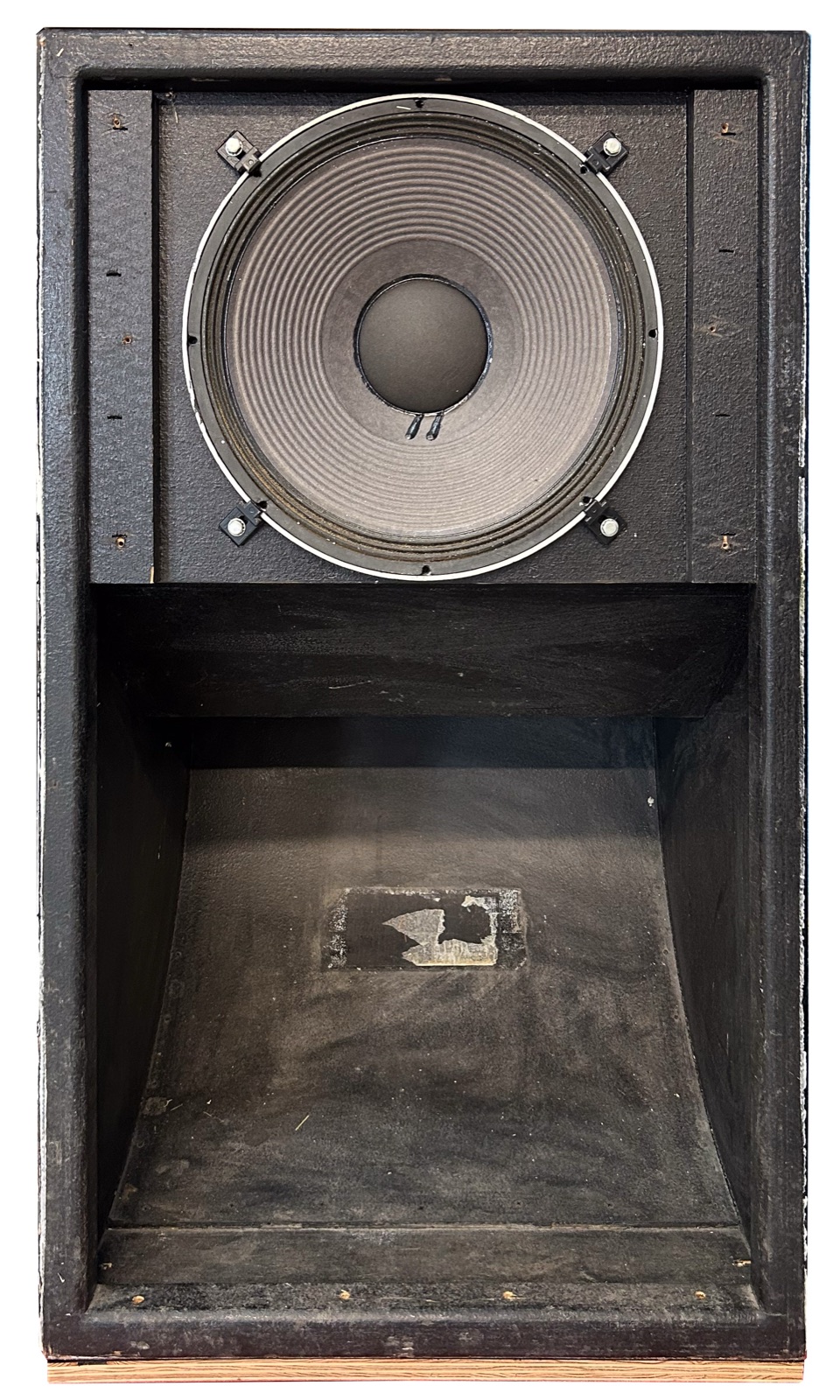
The scoops carry most of the bass. They are two folded, rear-loaded horn cabinets, each with one JBL 2226H 15 in driver. Until October 2026 they had Electro-Voice EVM-15L Series II drivers, and we moved those to the kicks. The scoops stand at the ends of the bottom row with the subs between them, and play 50 to 80 Hz.
The limit is the GX5's, about 465 W into 8 ohm, under the driver's 600 W rating. The subs are trimmed 4.9 dB under the scoops so the two hit their limiters together (Section 2): +3 dB with the scoops at +8. Set by ear 2026-10-22 and trimmed 2026-10-23; the paper model's -7.5 was far too bright.
The scoops first ran EV EVM-15Ls. Those have only 3.3 mm of Xmax, and in these horns they ran out of cone travel at about 130 W, long before they got hot. The JBL 2226H has 7.62 mm, 2.3 times as much, and three times the power rating.
Measured close up with REW (2026-10-19), the two drivers are within about 1-3 dB of each other in the scoops at low level. The horn sets the sensitivity, not the driver: about 100 dB at 50 Hz, 105 dB at 60 Hz (the horn's quarter-wave peak) and 102-103 dB from 70 to 100 Hz (2.83 V, 1 m, one scoop on the floor). So the swap costs nothing at low level and adds headroom at the top.
Modelled with the whole horn (measured mouth, throat and rear chamber; path estimated), the 2226H at 465 W reaches about 76 % of Xmax. A simpler model without the horn put it at 91 %. Either way it stays inside its travel, so the scoops are now limited by the amplifier, not the cone.
Clean output is 4 to 8 dB above the EVM's: the most at 45-50 Hz, about 4-6 dB at 60-80 Hz.
Throat air speed stays low, about 4.3 m/s peak at 465 W, so no chuffing.
The DCX limiter is broadband and sits after the filters, so it caps voltage, not excursion. A loud enough low tone, such as turntable rumble or feedback, would reach the full limiter voltage at any frequency. The steep LR48 high-pass makes that impossible below about 40 Hz: it would need more than +22 dBu at the input.
The high-pass stays at 50 Hz. The REW sweep confirmed it: the scoop is already 10 dB down at 45 Hz and 20 dB down at 30 Hz, and the subs cover that range.
Scoops and rear-loaded horns are known for a 3-6 dB dip around 70-90 Hz. These scoops do not show it. Measured, the response rises smoothly to a broad peak at about 90-100 Hz and rolls off above about 120 Hz.
The kick crossover stays at 80 Hz. Because the scoops are strong to about 120 Hz, a 100 Hz crossover is an option to try by ear; the EVM kicks come alive above 100 Hz.
The horn mouth is small for 50-80 Hz, so at the bottom the scoop works as a short, undersized horn: modest gain and some ripple. For deeper bass the cabinet would have to change, not the driver. UK rigs run 18 in or 21 in scoops for that reason.
Drive the bass until the sub and scoop limiter lights flash together, hold it there and listen to the scoops.
Heard with the old EVM drivers: clean at the limiter. "Doesn't sound loud, but it gets hard to talk to people."