
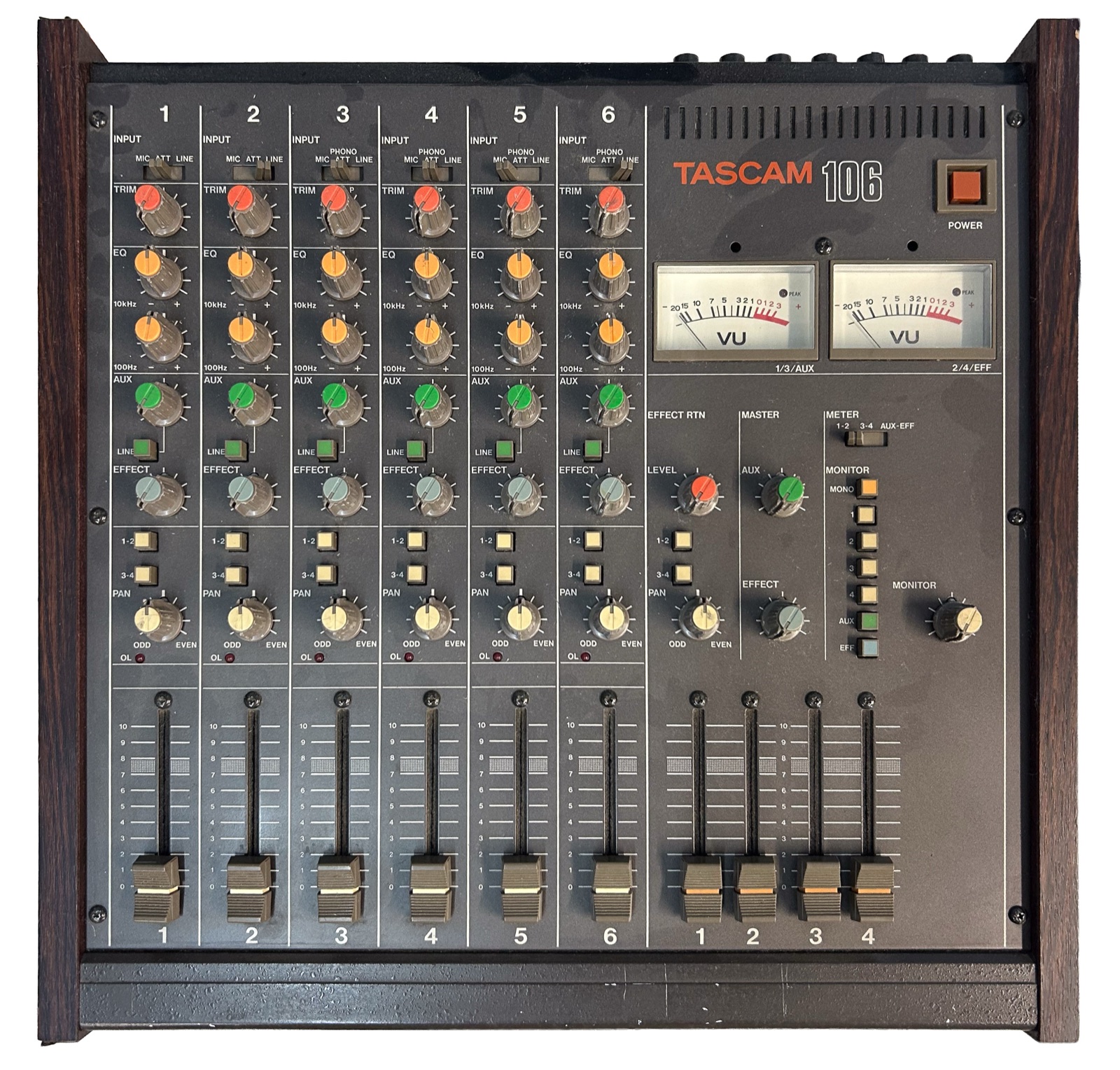
Two turntables play into the M-106's two rightmost channels, 5 and 6. Each deck is summed to mono by an RCA Y-adapter (page 10-6), so it needs one channel and one fader. Channel 3 is the toasting mic and channel 4 the dub siren; they feed the mains only. The decks feed both buses: bus 1 is the BASS (subs and scoops) and bus 3 the MAINS (kicks, mid and horn). Master fader 1 rides the bass and master fader 3 the mains. The DCX splits each bus into its bands.
The echo pedal is fed from the AUX send and the spring tank from the EFFECT send. Both come back on channels 1 and 2, assigned to the mains only, so the subs and scoops always stay dry. Returning on channels rather than the EFFECT RTN section lets them feed back. With the mic and the siren, all six channels are in use.
| Control | Decks: ch 5 (A), ch 6 (B) | Mic ch 3, siren ch 4 | Returns: ch 1 + 2 |
|---|---|---|---|
| Input switch | PHONO | ch 3 MIC, ch 4 LINE | ch 1 LINE, ch 2 MIC |
| PAN | fully ODD | fully ODD | fully ODD |
| ASSIGN | 1-2 and 3-4 pressed | 3-4 only | 3-4 only |
| AUX (green), pre-fader | echo throws. AUX LINE button OUT (pressed, the send is silent). | echo on the voice and the siren | ch 1: feedback swell. ch 2: taste. |
| EFFECT, post-fader | spring throws | spring throws | ch 1: taste. ch 2: NEVER (howl). |
| EQ | flat to start | mic: LOW down (no boom, less feedback) | ch 2: LOW down if the spring booms |
| Fader | one per deck; tape-mark a start point | mic: up only while toasting | to taste; tape-mark a start point |
The ¼" outs are near pro level. They are unbalanced: keep the runs short.
| Qty | Cable | From -> to |
|---|---|---|
| 2 | ¼" TS male -> XLR male, mixer-to-rack length | PGM OUT 1 -> DCX IN A; PGM OUT 3 -> DCX IN B |
| 1 | ¼" TS <-> ¼" TS, short | AUX OUT -> delay pedal IN |
| 3 | ¼" TS male <-> RCA male, short | pedal OUT -> ch 1 LINE IN (RCA); EFF OUT -> tank IN (RCA); tank OUT (RCA) -> ch 2 MIC IN (¼") |
| 2 | RCA Y-adapter, 2 female -> 1 male, short, molded | each deck's L + R -> one phono jack (ch 5, ch 6) |
| 1 | mic cable, XLR female -> ¼" male | toasting mic -> ch 3 MIC IN |
| 1 | siren cable (¼" or RCA, to suit the siren) | dub siren -> ch 4 LINE IN |
| - | turntables' own RCA leads | -> the Y-adapters; ground wires -> GND post |
Mount it flat, open side down, on foam, away from amps and transformers. Specifications from the M-106 owner's manual (p. 38) and the Tascam catalog.
Mashup Sound is mono, like any sound system. Every box plays the whole record, so nobody in the crowd misses half the mix by standing on the wrong side. Each deck is summed to mono before the mixer with an RCA Y-adapter, so it needs one channel and one fader.
The two coils of a moving-magnet cartridge are matched. Joined in parallel they give exactly the average of left and right, from half the source impedance, into the same 47k ohm phono input. Mono material plays at the same level. It is the same circuit as wiring the cartridge itself for mono.
There are seven ways to turn a stereo turntable into a mono source. All of them give the same thing at the speakers: left plus right. They differ in where the sum happens, what it costs, and what they ask of the cartridge.
| # | Method | Where | Cost | Verdict |
|---|---|---|---|---|
| 1 | Pan two channels | mixer | none | works; two faders a deck |
| 2 | RCA Y-adapter | phono lead | a few $ | used here |
| 3 | Summing box | phono lead | about $30 | a Y with a ground post |
| 4 | Mono-wired cartridge | headshell | two jumpers | mono at the source |
| 5 | True mono cartridge | headshell | about $460 | mono records only |
| 6 | MONO switch | after the preamp | in the gear | if the gear has one |
| 7 | Resistor sum | line level | a few $ | for LINE-out decks |
Methods 2 to 4 are the same circuit in different places: the two cartridge coils joined in parallel. Method 1 sums in the mixer, 6 and 7 after a preamp, and 5 never makes stereo in the first place.
The details, pros and cons follow, then what mono does to a record and why it is quieter (pages 10-11 and 10-12).
The old setup: each deck's L and R into two channels, both panned to the same bus, and the mixer adds them.
A 2 female -> 1 male RCA adapter joins L and R at phono level (page 10-6).
The Y inside a small metal box: two RCA in, one out, a ground post, and if wanted a MONO/STEREO switch.
Two short jumpers on the cartridge pins: L+ (white) to R+ (red), and L− (blue) to R− (green). Both RCA plugs then carry mono; use either one.
Good DJ cartridges for this: the Shure M44-7 (old school; no longer made, used about $100 to $175, JICO still makes styli), Audio-Technica AT-XP5 or Ortofon OM Pro S (new, about $60 to $90).
A cartridge that responds only to side-to-side groove motion, for example the Ortofon 2M Mono (about $460).
Many phono preamps, DJ mixers and old hi-fi amplifiers have a MONO button that adds L and R at line level.
For a deck with a built-in preamp (LINE out), or after an outboard phono preamp: a 1k ohm to 10k ohm resistor in each of L and R, joined after the resistors, into a LINE input.
We run one stack, so it gets one signal. Every box plays the whole record, people stand all over the room, and nobody misses half the mix on the wrong side. Stereo through one stack would only lose parts of the record.
A stereo groove is a V with two walls at 45 degrees. The left channel is cut into the inner wall and the right channel into the outer wall, and a stereo cartridge reads each wall with its own coil.
The stylus can move only two ways, so the two channels come out as two motions:
Everything in the middle of the mix is the same on both walls and moves the stylus side to side. A mono record is cut side to side only, so on a mono record anything up and down is noise.
Most groove noise is not shaped like music. Turntable rumble and warped records push the stylus up and down. Dust, scratches and wear hit one wall at a time, so they come out differently in L and R. When L and R are added:
The gain is biggest on mono pressings played with a stereo cartridge, which hears up-and-down groove noise the mono cutter never put there. Summing throws that noise away.
These pages explain how to play the Mashup Sound system with the Tascam M-106: two turntables, a toasting mic, a dub siren, a delay pedal and a spring reverb tank. Wiring and settings are on pages 10-1 to 10-5, mono decks on 10-6 to 10-12; from here on it is about using it.
Each deck is one channel and one fader. The mic, the siren and the effects go only into the mains, so the subs and scoops get records only and always stay dry.
Everything off at the M-106: all AUX and EFFECT knobs at zero, faders 1 + 2 (returns) down, master faders 1 and 3 down.
Put a record on Deck A. Bring its fader to the tape mark, then raise masters 1 and 3 together to their marks. Set the channel TRIM so the meters (METER switch at 1-2) sit around 0 VU on loud passages. Match Deck B the same way, so changing decks never changes the level.
Echo: AUX on Deck A to about noon, MASTER AUX to noon. Raise fader 1 until one repeat sits just under the record. Tape-mark it. Set the pedal to 100% wet (no dry signal) and pick a delay time that fits the tempo. Dotted eighths or quarter notes are the usual choices.
Spring: EFFECT and MASTER EFFECT up high (a tank wants a hot signal). Bring up the channel 2 TRIM until the splash sits under the record. If it hisses, more send and less trim. If it booms, turn channel 2 LOW down.
Mic: toast at full voice and set the channel 3 TRIM so the meter peaks near 0 VU. EQ LOW down. Siren: its own volume at about three quarters, then the channel 4 TRIM to peak near 0 VU. Tape-mark both faders.
Return all sends to zero. You are ready.
The M-106 has no cue buttons, so use the spare buses. Turn the waiting deck's PAN fully to EVEN: it now feeds buses 2 and 4, which go nowhere. Press MONITOR 2 and listen on headphones. To bring it in, sweep its PAN back to ODD in time with the music; the sweep fades it into the system.
Bass drop. Pull master fader 1 on the last beat of a phrase: subs and scoops disappear, the rest plays on. Slam it back on the one. The bigger the gap, the bigger the return.
Sub-only drop. The reverse: pull master fader 3. Only the 40–80 Hz bass remains, dry. Good for a few bars before the full drop-back.
Full stop. Pull masters 1 and 3 together for a beat, then back. Do it on the beat or not at all.
Bass tilt. On the playing deck, ride EQ LOW up a few dB to fatten a thin record, or down to clear space before a drop.
Rewind (pull-up). Spin the record back by hand and restart. Pull master fader 1 down during the spin: the rewind throws out deep rumble that the subs do not need. The limiters will catch it anyway, but the fader is gentler on the drivers.
Echo throw. Flick AUX up on the playing deck on the last word or a snare hit, then straight back to zero. The repeats ring out on fader 1.
Drop to echo. AUX is pre-fader, so with AUX up, pull the deck's fader down: the dry record vanishes but keeps feeding the echo, and only the repeats play. Bring the fader back on the one.
Feedback swell. Slowly raise AUX on channel 1. The echo feeds back into itself and builds toward a roar. Pull fader 1 to kill it instantly. Keep the pedal's tone control dark: the horn and the piezos get all of the howl's treble.
Darker repeats. Turn EQ HIGH down on channel 1 so each repeat sits behind the record, the way old tape echoes do. EQ LOW down on channel 1 stops the repeats muddying the bass.
Time warp. While repeats are ringing, turn the pedal's time knob. The pitch bends as the delay stretches.
Spring splash. Flick EFFECT on the playing deck, same move as the throw. For the crash, kick or shake the tank.
Echo into spring: EFFECT on channel 1. Spring into echo: AUX on channel 2. Use a little of either.
NEVER turn up EFFECT on channel 2. It feeds the spring into itself and makes an instant, loud howl.
Toasting. Bring the mic fader up only while talking or chanting, and back down after. An open mic in front of a sound system picks up the stack.
Echo on the voice. Flick AUX on channel 3 on the last word of a line: the word repeats over the record.
Spring on the voice. A touch of EFFECT on channel 3 puts the voice in a small, metallic room. Throw it on a shout.
Siren over the drop. Pull master fader 1 for a bass drop, play the siren over the gap, and slam the bass back in on the one.
Siren into echo. AUX up on channel 4 while the siren plays, then pull its fader: the echo carries the siren on after it stops.
Feedback. If the mic rings or howls, pull its fader first, then turn EQ HIGH and LOW down on channel 3. Toast from behind or beside the stack, never in front of it, and never point the mic at a box.
The mic and the siren feed the mains only, so the subs and scoops never carry them.
The DCX limiters protect every driver whatever happens at the mixer. Feedback and rewinds can still be loud in the room: keep fader 1 under a finger whenever the echo is building.
Watch the sends with the METER switch at AUX-EFF. Pinned meters mean the pedal or tank is being overdriven; back off the MASTER knobs.
| Symptom | Likely cause and fix |
|---|---|
| Hum from the decks | Ground wires not on the GND post. |
| Echo send silent | AUX LINE button pressed on the deck channels. Release it. |
| Spring hiss | Too little send, too much channel 2 trim. Swap them. |
| Spring booms or rattles | Channel 2 LOW down; tank on foam, away from amps. |
| Crackle on the spring | Loose RCA or adapter at the tank. Reseat it. |
| Bass and mains out of balance | Masters 1 and 3 not on their marks. |
| Cue deck heard in the system | Its PAN not fully EVEN. |
| A deck thin, half missing or distorted | Y-adapter loose or one plug out; turntable switched to LINE (set PHONO). |
| Mic howls | Feedback: fader down, EQ HIGH and LOW down, toast from behind the stack. |
| Siren distorts | Siren volume and channel 4 TRIM too high. |