
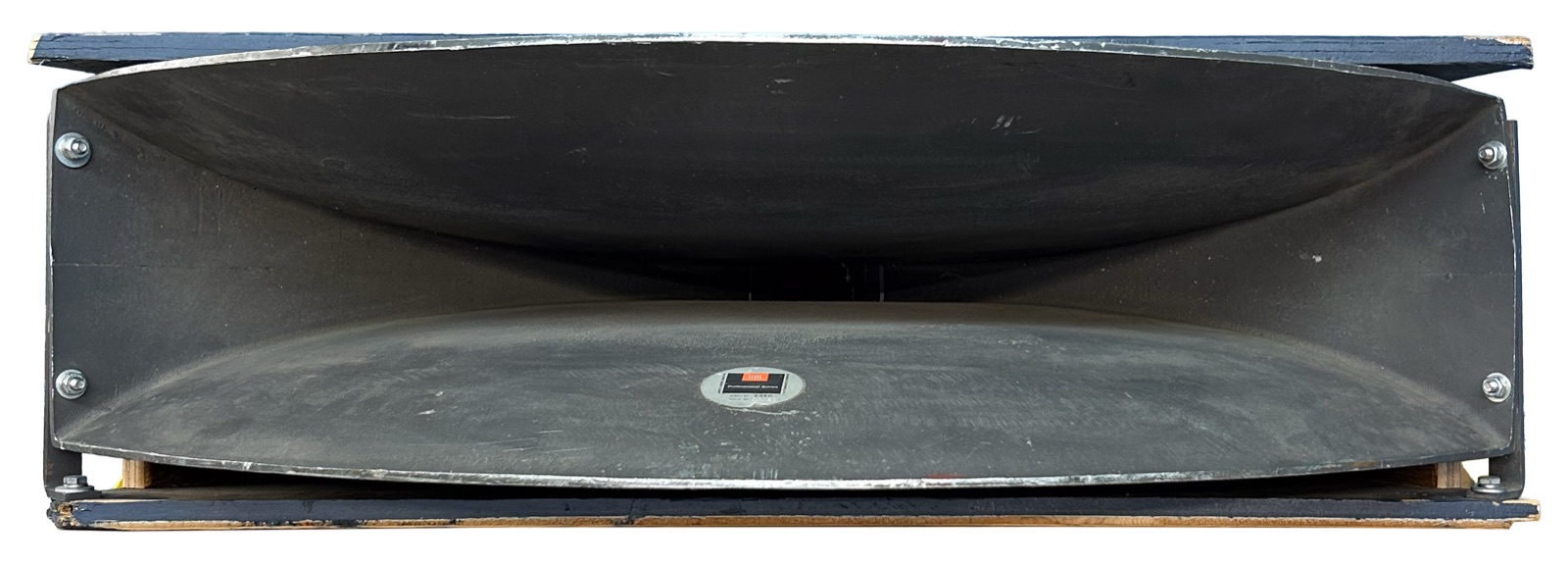
The horn is the top of the Mashup Sound stack: one JBL 2440 compression driver on a JBL 2350 radial horn, joined by a JBL 2328 throat adaptor. It plays 700 Hz to about 10 kHz. Above that the piezo plate (Section 8) carries the top octave on the same amplifier channel.
Response on the 2350: within 2 dB from about 700 Hz to 9 kHz, with a 2-1/2 dB bump near 8 kHz. Above that it falls off fast: -6 dB at 10 kHz, -16 dB by 11.6 kHz. JBL's own sheet gives +/-3 dB from 500 Hz to 10 kHz. Everything above 10 kHz comes from the piezo plate.
Vertical coverage is narrow: at 10 kHz, -8 dB at 15 deg off axis and -12 dB at 30 deg. Mount the horn at head height or above and aim it into the crowd. Aimed at the ceiling, most of its output is wasted.
Not 118 dB. The 2440's 118 dB rating is measured with 1 mW into a terminated tube. On the 2350 horn it is 111 dB for 1 W at 1 m. Older notes that use 118 dB are about 7 dB high.
Pad check with an ohmmeter: pin 2 to 2 and pin 3 to 3 read the same, not zero; pin 1 to 1 reads 0 ohm. Pin 3 at 0 ohm means a one-leg pad: return it.
We set it by ear at +6 dB on 2026-10-22 and raised it to +8 on 2026-10-23, when REW showed 1-4 kHz about 3 dB under the house curve. The paper model's +11.5 was too bright. The gain sits before the limiter, so it does not change the horn's protection.
Measure the pad (owed): horn unplugged at GX5 #4 B, a steady 1 kHz tone into the mixer, meter on AC volts across GX5 #4 B's output. Read it with the pad in, then with the DCX plugged straight into the amp at the same tone level (keep it low). Pad = 20 × log10(volts without ÷ volts with): 10 times = 20 dB. Horn limiter = -24.4 + pad (20 dB gives -4.4; 18 dB gives -6.4). Change the limiter, not the gain.
Why, if the horn sounds right: the by-ear gain hides any pad error. A pad really at -17 dB lets the limiter pass about 120 W, double the 2440's rating; at -23 it limits at 30 W.
A horn that turns harsh when loud has three causes stacked in the same place: the 2440's response rises through 2 to 5 kHz, hearing is most sensitive at 2 to 5 kHz, and compression-driver distortion climbs with level in the same region. Together they sound aggressive rather than bright. The horn is not the cause. JBL damped the 2350 with aquaplas to stop it ringing.
The low ratio makes the cut progressive: 0.4 dB of cut for every dB over the threshold, so about 4 dB when pushed 10 dB over, and the full 10 dB only when pushed about 27 dB over. The fast attack catches the bite of snares and voices; the release lets the top recover between phrases.
Outdoors: no walls throw the top back and air soaks up treble, so let the horn loose: start around -20 dB and -6 dB, set by ear, and store it as its own preset.
Indoor option from the earlier notes, not in the current preset: a second preset with the mid / horn crossover at 1.2 kHz (LR48 both sides). It takes stress off the 2440 where the harshness starts. It would need the mid to play to 1.2 kHz.
The 2440 is the most fragile and least replaceable driver in the rig. Its diaphragms are expensive and increasingly scarce.
The July notes proposed a 22 uF, 100 V non-polarized capacitor in series with the 2440: a 452 Hz first-order high-pass that also blocks DC. They also suggested a different connector on the horn leg so an amplifier lead cannot be swapped onto it, and labeling the DCX outputs. None of these is in the current build (rig doc V3).